
How to Explain Flying to a Child with Autism: A Practical Guide for UK Families
Learn how to explain flying to a child with autism using simple, calming strategies. Practical UK family travel advice for autistic children, airport anxiety, and neurodiverse holidays.
TRAVELLING WITH A NEURODIVERSE CHILD
6/9/20264 min read
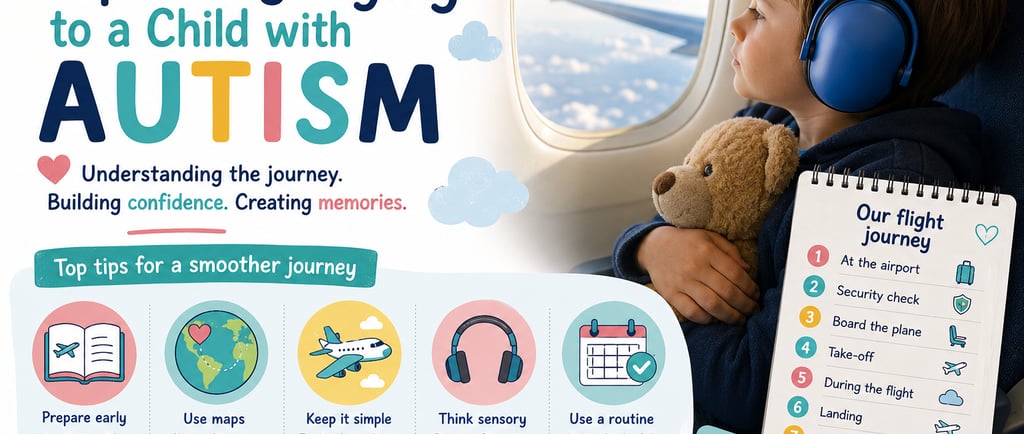
How to Explain Flying to a Child with Autism: A Calm and Practical Guide for UK Families
Travelling by plane can feel exciting for many children—but for autistic children or neurodiverse kids, the idea of flying can also feel confusing, overwhelming, or even frightening. The concept of sitting inside a giant machine thousands of feet in the air, travelling to another country, hearing unfamiliar noises, and coping with busy airports can trigger anxiety long before your holiday even begins.
The good news is that preparation can make a huge difference. By helping your child understand how planes work and what happens during air travel, you can reduce uncertainty and build confidence before your trip.
If you are planning your first flight as a neurodiverse family, our guide to travelling with a neurodiverse child is a helpful place to start before introducing the idea of flying itself.
Why Flying Can Feel Difficult for Autistic Children
For many autistic children, anxiety often comes from the unknown. Flying includes many unfamiliar experiences, including:
Loud airport announcements
Busy queues and crowds
New smells and sensations
Changes in routine
Waiting for long periods
Feeling trapped in a confined space
Not understanding how flying works
Some children may also struggle with abstract concepts. The idea that a plane can “stay in the sky” or travel to another country in just a few hours can feel difficult to process.
Helping children understand the practical side of flying in a simple, visual, and predictable way can reduce fear significantly.
Start Talking About Flying Early
Preparation should ideally begin weeks or even months before your holiday.
Avoid introducing the idea suddenly. Instead, slowly build familiarity through conversation, pictures, videos, and play.
You could begin with simple explanations such as:
“Aeroplanes are special vehicles that carry people through the sky.”
“Pilots are trained to fly planes safely.”
“Airports are places where planes take off and land.”
“The plane follows roads in the sky called flight paths.”
Keep explanations short and concrete. Many autistic children process information better when it is clear and literal.
Use Visual Supports
Visual learning tools are often incredibly helpful for autistic children.
Try using:
Picture books about flying
Airport social stories
Videos showing airports and planes
Maps and globes
Toy aeroplanes
Simple diagrams
Showing your child exactly what will happen step-by-step can make the experience feel more predictable.
You could create a visual timeline including:
Packing suitcases
Travelling to the airport
Checking in
Going through security
Waiting at the gate
Boarding the plane
Take-off
Flying
Landing
Arriving in another country
Many autistic children feel calmer when they know what comes next.
Explaining How Planes Fly
One of the biggest worries children may have is understanding how something so large can stay in the air.
Keep explanations simple and age-appropriate.
You might say:
“Aeroplanes have very strong wings and powerful engines. When the plane moves very fast, the wings help lift it into the sky—just like how birds use their wings.”
Some children benefit from comparing flying to things they already understand:
Birds gliding through the air
Kites flying in the wind
Cars travelling on roads
Boats moving across water
Avoid giving too much technical detail unless your child enjoys mechanics or engineering topics.
For children who love facts, you can explain that:
Pilots train for many years
Planes are checked carefully before every flight
Air traffic controllers help guide planes safely
Flying is one of the safest forms of transport
Facts and predictability can sometimes reduce travel anxiety in autistic children.
Use Maps to Explain Travelling to Another Country
The idea of travelling to another country may feel abstract for younger children or children who struggle with spatial understanding.
Using a globe or map can help make the journey more concrete.
Show:
Where the UK is
Where your destination is
The route the plane will take
How long the journey might be
You could explain:
“The plane helps us travel much faster than a car or train. Instead of driving for days, we can fly there in a few hours.”
Some autistic children enjoy counting down the journey time or tracking flights online before travelling.
Watch Videos of Airports and Flights
Watching airport walkthroughs on YouTube can help autistic children understand what to expect.
Look for videos showing:
Check-in desks
Security procedures
Boarding gates
Cabin interiors
Take-off sounds
Turbulence explanations
Seeing real-life examples ahead of time can make the airport environment feel less intimidating.
Some airlines also provide autism-friendly travel resources online.
Practise Through Play
Role play can be extremely effective for helping autistic children process new experiences.
You could:
Pretend to board a plane
Use toy suitcases
Practise wearing seatbelts
Rehearse listening to announcements
Act out passport checks
Play allows children to process information safely and repeatedly.
If your child enjoys routines, practising airport scenarios several times can build confidence.
Explain Sensory Experiences Honestly
It is important to prepare children for the sensory side of flying.
Be honest but reassuring about:
Engine noise
Ear popping during take-off and landing
Seatbelt signs
Crowds
Bright lights
Waiting times
You might say:
“The plane can be noisy when it starts moving, but that is completely normal.”
Or:
“Your ears might feel funny for a few minutes when the plane goes up or down.”
Preparing children in advance can reduce panic if these sensations happen unexpectedly.
Many neurodiverse families find sensory aids helpful, including:
Ear defenders
Noise-cancelling headphones
Fidget toys
Favourite snacks
Tablets or comfort items
Weighted lap pads
Prepare for Meltdowns Without Fear
Even with preparation, flying can still feel overwhelming for autistic children.
That does not mean your holiday will fail.
Meltdowns are often a sign of sensory overload, anxiety, exhaustion, or communication difficulties—not bad behaviour.
Our guide to coping with meltdowns during flights includes practical strategies for reducing stress during air travel.
Helpful strategies include:
Boarding early where possible
Bringing familiar comfort items
Using airport assistance services
Choosing quieter flight times
Allowing movement breaks
Keeping routines as consistent as possible
Focus on the Positive Parts of Travel
While preparation is important, try not to make flying sound frightening.
Balance explanations with excitement about:
Swimming pools
Beaches
Hotels
New foods
Family adventures
Seeing new places
You could create a countdown calendar or visual holiday planner to help build positive anticipation.
Many autistic children thrive when they can connect the journey to a meaningful outcome.
Use Autism-Friendly Travel Resources
There are several excellent UK resources for families travelling with autistic children.
The National Autistic Society holiday guide for parents includes practical advice on preparing autistic children for holidays and travel routines.
Combining expert guidance with your own understanding of your child can help you create a calmer travel experience.
Remember Every Child Is Different
Some autistic children love planes immediately. Others may need weeks of preparation before feeling comfortable.
There is no “right” way to travel as a neurodiverse family.
Your holiday may look different from someone else’s—and that is completely okay.
The goal is not perfection. The goal is helping your child feel safe, supported, and understood while creating positive family memories together.
With patience, preparation, and flexibility, flying can become a manageable—and even enjoyable—experience for autistic children and their families.


