Hidden Disabilities Sunflower Lanyards for Travel | Autism & Neurodiverse Family Airport Support
Learn how sunflower lanyards support autistic and neurodiverse travellers at airports and on holiday. Discover how hidden disability lanyards reduce travel anxiety and help families access support while travelling abroad
TRAVELLING WITH A NEURODIVERSE CHILD
5/21/20264 min read
Sunflower Lanyards and Travel: Supporting People with Hidden Disabilities
Travelling can be exciting, but for many families raising neurodiverse children or living with hidden disabilities, it can also feel overwhelming. Busy airports, unfamiliar environments, long queues, loud announcements, and disrupted routines can quickly become stressful.
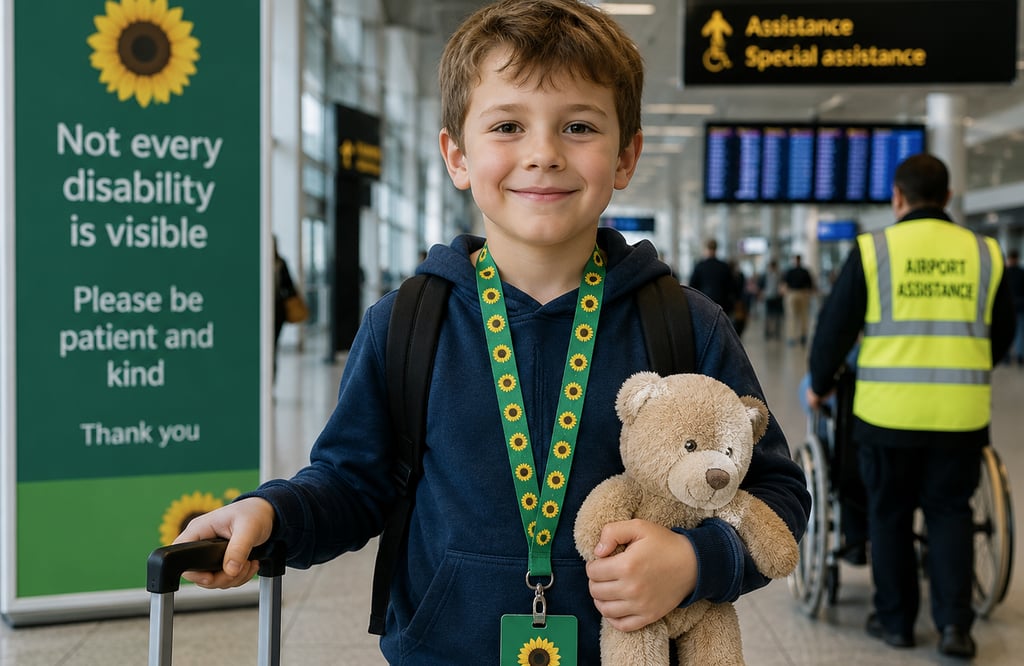
That’s why the Hidden Disabilities Sunflower lanyard has become such an important tool for many travellers across the UK and beyond. The sunflower symbol is now recognised in airports, shops, transport hubs, and public spaces as a discreet way to indicate that someone may need additional support, patience, or understanding.
If you are preparing for a family holiday, especially when travelling with a neurodiverse child, understanding how sunflower lanyards work can help make your journey smoother and less stressful.
What Is a Sunflower Lanyard?
The Hidden Disabilities Sunflower is a green lanyard decorated with yellow sunflowers. It is used internationally to help identify people with non-visible disabilities or conditions. The aim is simple: to let staff and members of the public know that the wearer may need extra support, more time, or greater understanding. (HDS Sunflower)
Unlike visible disabilities, hidden disabilities are not immediately obvious. Someone may appear fine outwardly while struggling with sensory overload, anxiety, communication difficulties, chronic pain, fatigue, autism, ADHD, or another condition.
The sunflower lanyard provides a subtle and non-verbal way to communicate these needs without requiring the person to repeatedly explain themselves.
The scheme was first introduced at London Gatwick Airport in 2016 and has since expanded globally. (Lupus UK)
What Are Hidden or Non-Visible Disabilities?
A hidden disability — sometimes called a non-visible disability — is a condition that may not be immediately apparent to others but still affects everyday life.
Examples include:
Autism
ADHD
Sensory processing differences
Anxiety disorders
PTSD
Dementia
Chronic fatigue
Diabetes
Hearing loss
Learning difficulties
Chronic pain conditions
The official Hidden Disabilities Sunflower website explains that non-visible disabilities can affect communication, sensory regulation, mobility, social interaction, and emotional wellbeing.
For families travelling with autistic children or neurodiverse children, airports can be particularly difficult due to crowds, noise, waiting times, and sudden changes in routine.
How Sunflower Lanyards Help During Travel
One of the biggest benefits of the sunflower lanyard is that it can reduce the pressure of having to constantly explain your child’s needs.
Many airport staff are trained to recognise the sunflower symbol and understand that the wearer may require:
More time
Clearer communication
Extra patience
Reduced sensory stress
Help navigating queues or security
Airports including Heathrow Airport, Manchester Airport, London Stansted Airport, and London Luton Airport all recognise sunflower lanyards and provide additional support for travellers with hidden disabilities. (Heathrow Airport)
Some airports may offer:
Access to quieter routes
Assistance through security
Priority or family lanes
Sensory rooms
Pre-boarding support
Staff trained in neurodiversity awareness
However, it is important to understand that sunflower lanyards do not automatically guarantee fast-track access or special privileges. Support varies depending on the airport and airline. (Gatwick Airport)
Why Sunflower Lanyards Can Be Helpful for Neurodiverse Children
For many autistic children, travel anxiety starts long before arriving at the airport.
The uncertainty of travel, unfamiliar sensory input, and changes to routine can trigger stress or meltdowns. Wearing a sunflower lanyard can help create a more supportive environment and reduce misunderstandings from staff or other passengers.
Parents often report that the lanyard helps staff recognise when a child may:
Become overwhelmed
Need extra processing time
Struggle with transitions
Experience sensory overload
Find communication difficult
When paired with careful preparation, sunflower lanyards can make holidays feel more manageable.
You can also read our guide to supporting your neurodiverse child at the airport for additional practical strategies.
Are Sunflower Lanyards Only for Autism?
No — and this is a common misconception.
The sunflower lanyard is for anyone with a hidden disability or condition who feels they may benefit from additional understanding or support.
There is no official “eligibility test,” and people do not need to disclose personal medical information to wear one. (Happiful)
Some people wear sunflower lanyards temporarily during periods of illness or recovery, while others use them daily.
The scheme is designed to promote inclusivity rather than force people to explain or justify their needs.
Where Can You Get a Sunflower Lanyard?
Many UK airports provide sunflower lanyards free of charge at assistance desks or customer service points. (Heathrow Airport)
You can also order official products directly from the Hidden Disabilities Sunflower website before you travel.
Some supermarkets, hospitals, railway stations, and public venues also distribute them.
If you are travelling abroad, it can be useful to check whether your destination airport recognises the scheme in advance. The Sunflower programme is now supported in many countries worldwide, including across Europe, North America, Australia, and parts of Asia. (HDS Sunflower)
Tips for Using a Sunflower Lanyard While Travelling
1. Explain It to Your Child First
If appropriate, help your child understand what the lanyard means and why they are wearing it.
For some children, this can reduce anxiety because they know staff may be more understanding if they feel overwhelmed.
2. Combine It With Airport Assistance
A sunflower lanyard is helpful, but you may also want to pre-book airport special assistance if your child requires more structured support.
3. Carry Sensory Supports
Even with a lanyard, airports can still be overwhelming.
Helpful items may include:
Ear defenders
Fidget toys
Snacks
Comfort items
Tablets or devices
Visual schedules
4. Allow Extra Time
Travelling with neurodiverse children often takes longer than expected. Building in extra time reduces stress for everyone.
5. Advocate When Needed
Although awareness is growing, not every staff member fully understands hidden disabilities. It is okay to calmly explain your child’s needs if necessary.
The Importance of Greater Awareness
One of the most positive aspects of the sunflower scheme is that it has helped increase public awareness of hidden disabilities.
Many families of autistic or neurodiverse children experience judgement when a child appears distressed in public. Because hidden disabilities are not always obvious, behaviours can easily be misunderstood.
The sunflower lanyard encourages empathy and understanding rather than assumptions.
For parents travelling with autistic children abroad, that small symbol can sometimes make a huge emotional difference.
Final Thoughts
Family travel with a neurodiverse child may look different from traditional holidays — and that is completely okay.
Tools like sunflower lanyards are helping make airports and public spaces more inclusive for people with hidden disabilities. While they are not a perfect solution, they can reduce stress, improve communication, and help families feel more supported during travel.
Most importantly, they remind people that not every disability is visible.
With preparation, flexibility, and the right support systems in place, travelling with neurodiverse children can still be meaningful, memorable, and enjoyable for the whole family.
Further Reading
Hidden Disabilities Sunflower – For People With Non-Visible Disabilities
Preparing Your Neurodiverse Child for Going on Holiday
Supporting Your Neurodiverse Child at the Airport

